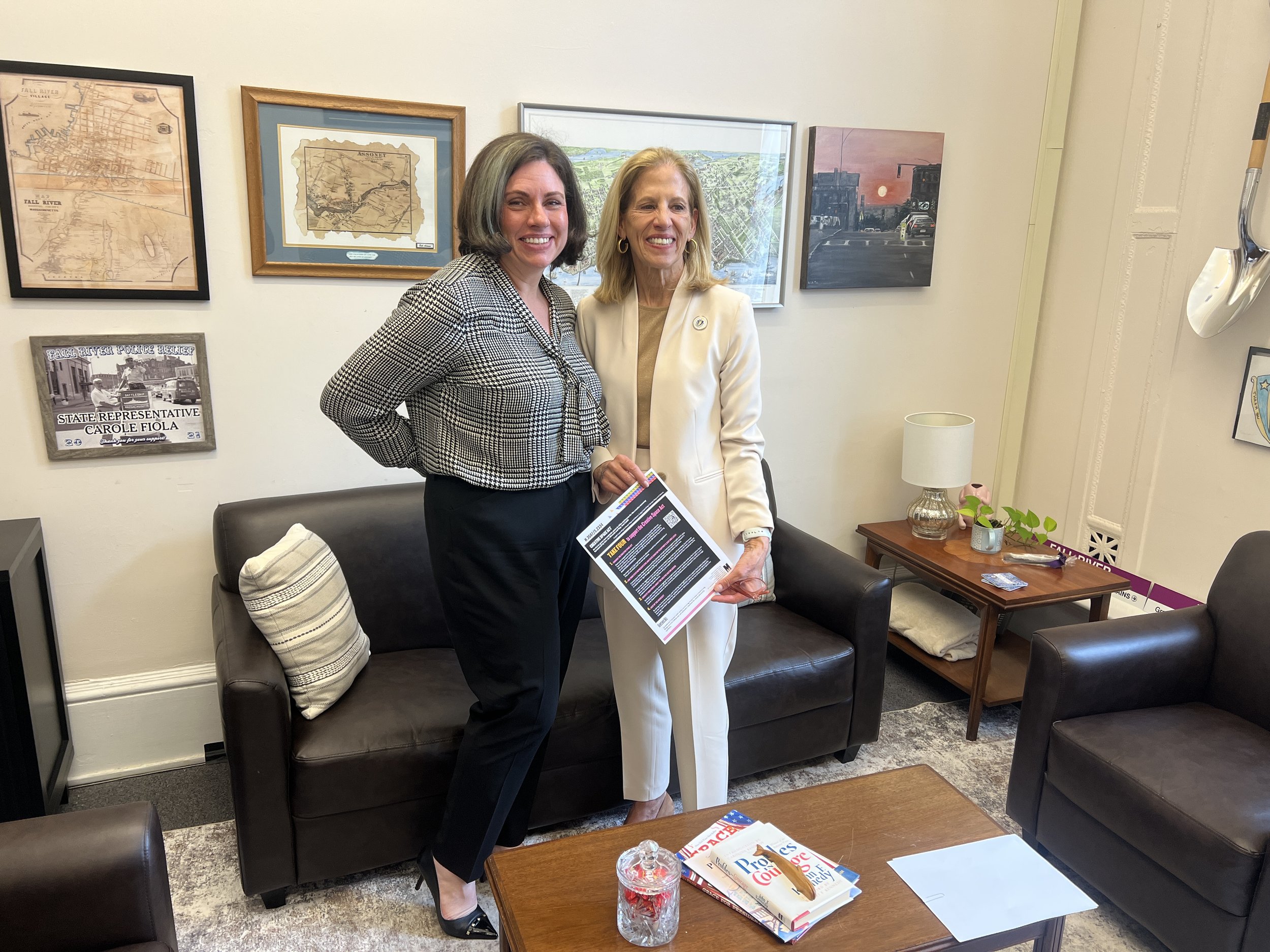
Emily Ruddock meeting with Rep. Carole Fiola, House Chair of the Joint Committee on Economic Development and Emerging Technologies, at her State House office in April 2026.
By Kelsey Rode, Director of External Relations
If you’re following what’s happening in Massachusetts state government right now, you’ve likely heard about the “Mass Wins Act” and that it’s making its way through the Legislature. An Act relative to Massachusetts winning global investment, talent, and innovation, referred to as the Mass Wins Act, is the economic development bond bill that Gov. Healey proposed in April with strategic investments for some of the state’s key industries, including artificial intelligence, quantum, climatetech, defense, and robotics. As the “economic development” part of the bond bill name suggests, this large policy package includes investments that will support various parts of Massachusetts’ economy, create jobs, strengthen the state’s competitiveness, lower costs for businesses, and attract more employers and commerce to the Commonwealth.
In May, MASSCreative’s Executive Director Emily Ruddock testified on a panel with Lourdes Alvarez Silva (Assistant Director of Arts and Culture at the Metropolitan Area Planning Council) and Ami Bennitt (Co-Founder of the #ARTSTAYSHERE Coalition) before the Joint Committee on Economic Development and Emerging Technologies to encourage the committee to include the Creative Space Act in the House and Senate economic development bond bills.
Emily and staff have also met with Senate Ways and Means, our bill sponsors (Rep. Dan Cahill and Sen. Liz Miranda), and the chairs of the Economic Development Committee (Rep. Carole Fiola and Sen. Barry Finegold) to advocate for the Creative Space Act and share why preserving and expanding creative work and presentation spaces is critical for our sector’s continued workforce development.
On June 22nd, the Economic Development Committee reported out H.5527 - their proposed economic development bill - and sent it to the Joint Committee on Bonding, Capital Expenditures and State Assets for the next round of review. The Economic Development Committee also included $25 million for the Downtown Vitality Grant Program, but did not include the Creative Space Act or CFF technical updates. The Bonding Committee will have their own hearing on this bill on July 2nd and we will provide testimony to their committee and urge them to include the Creative Space Act moving forward.
All of this needs to happen before the House and Senate release, open for amendments, and ultimately vote on their own proposals. The House and Senate will negotiate their final version of the Mass Wins Act before the end of July and send it to Gov. Healey’s desk for her signature.
WHAT IS A BOND BILL & WHAT DOES THAT MEAN?
Bond bills contain both capital authorizations and policies. They allow the state to borrow money for long-term, significant infrastructure projects, capital investments, and other public initiatives.
Bond bills authorize the state, or Treasurer, to issue bonds, which are loans that investors can buy. The state repays these bonds over time, typically with interest. This allows the state to fund large infrastructure and capital projects that it would not otherwise be able to afford through the state budget.
It’s typical to see bond bills with distinct focus areas move through the State House, like transportation, housing, capital, environmental, and economic development. We do not pass these other types of bond bills every session, but we do expect to pass an economic development bond bill each session.
The thing to watch for with bond bills is while they authorize spending, that’s not a guarantee that projects included in those bills will be funded. Additional advocacy is required to ensure the Administration prioritizes spending for those projects.
WHY IS THE ECONOMIC DEVELOPMENT BOND BILL SO IMPORTANT TO US?
Massachusetts has a mostly consistent track record of passing an economic development bond bill each session. As the saying goes, “it’s easier to attach something to a moving vehicle,” meaning it can be more expedient to move or pass policies if you attach them to other bills that are already expected to move through the State House. The state budget is another example of this because we need to pass a state budget each year, so advocacy groups will often try to get their bills included in the outside policy section - i.e., the part of the budget that just deals with policy.
This is one of the reasons why we’re paying such close attention to the economic development bond bill. It’s because the Mass Wins Act contains bond authorizations and policies that support artists and creativity in Massachusetts, and because it’s another vehicle that we can use to move the Creative Space Act this session.
As an example, we successfully passed the Downtown Vitality Act last session through the last economic development bond bill, called the “Mass Leads Act.” The Live Theater Tax Credit also passed through the Mass Leads Act.
As you can see, there are many steps to this process. As advocates, it’s important that we’re paying attention to what’s happening as these bills move and actively participating in each stage of their development, even after a bill is passed. Making sure these programs and projects are implemented requires as much as advocacy as it does to get them passed in the first place.
The MASSCreative Action Network is here to track all of this for you and to provide you with easy ways to take action when there’s a clear window to do so. You can directly support this year-round cultural policy advancement and government relations work by becoming a member of the MASSCreative Action Network.